
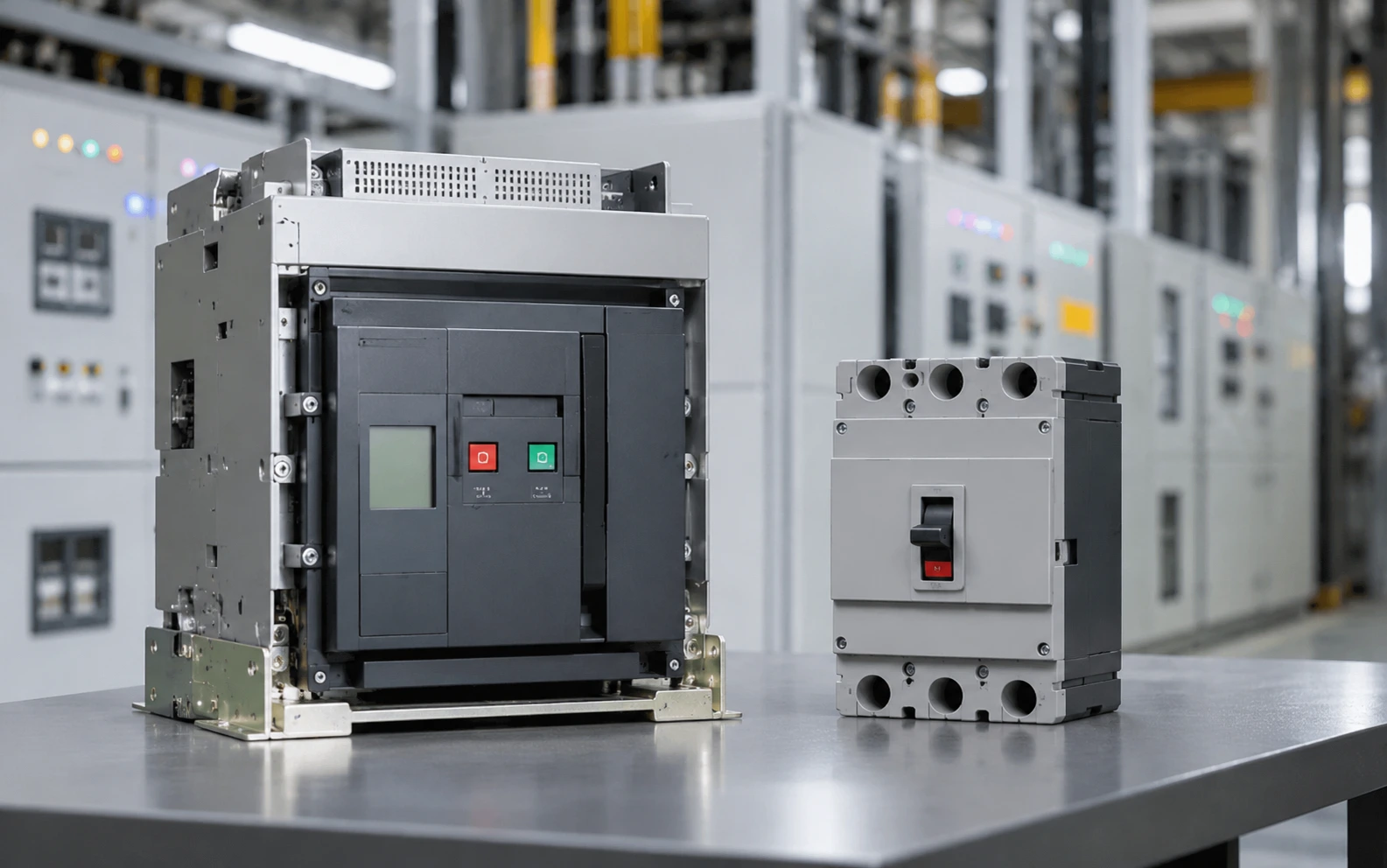
Every electrical panel has its own hierarchy, starting from one breaker which guards the whole installation, and many other installations guard the rest of the feeds and loads below it.
So the real question for electrical engineers and panel builders is not about which breaker is better, but most importantly, it is about “which breaker belongs where?”
To make the right decision, comparing an air circuit breaker vs. a moulded-case circuit breaker is indeed essential. Both carry functional points to overcome faults and protect people and equipment. But there’s a catch: both are built for different roles and purposes.
So, what you need to do is make a clear comparison of these and how ACB applications and MCCB applications are working individually.
Let’s break it down.
What is an Air Circuit Breaker?
An air circuit breaker, or ACB, uses air to extinguish the arc when it is interrupted with a fault. ACBs are designed for high-current and high-stakes parts of a system. The typical rating of an ACB ranges from about 630 A up to 6300 A.
Most ACBs have advanced electronic trip units, and when you look for one, you can make an inspection, test, or replace the breaker without a major teardown of the panel. Another key remark to note down is that ACBs also have a short-time withstand rating, and this lets them stay close during a fault. This way, the problem in the breaker will be cleared at first rather than waiting for a longer time.
What is a Moulded Case Circuit Breaker?
An MCCB is an electrical protection device that automatically interrupts electrical current flow when it leads to overloading or a short circuit. This is housed in a durable and moulded plastic case, and the ratings run from 16 A to 1600 A. The braking capacity of MCCB is 10 kA to 100 kA.
MCCBs have thermal-magnetic units, and many models have the capability of adjusting the settings. At the same time, they are quick to install and compact, which is a valid component because it makes them a solid workhorse of distribution panels.
MCCB vs ACB: Key Differences at a Glance

Key Point to Consider: Exact ratings of both MCCB and ACBs vary by manufacturer. In this context, always consider confirming with the manufacturer and the product datasheet.
Where MCCB and ACB Actually Fit
ACB Applications
Large industrial and commercial panels
Main incomers
Bus couplers
Generator incomers
Substations and data centres
Systems where uptime is important (the breaker must be in the frontline without any major shutdowns).
MCCB Applications
Outgoing feeders
Main distribution board
Motor circuits
Machinery operations
Sub-distribution panels (factors, hospitals, and commercial buildings).
Mid-size loads where the budget and the space of the environment are tight and small.
How to Choose the Right Circuit Breaker
Now you know how ACB and MCCBs actually work and what they stand for. Let’s look at the major points that make your selection process of a circuit breaker easy.
Start with the current rating: If your load is 1600 A, ACB will be the best choice.
Check the prospective fault fuel: The capacity of the breaker must need an exceeding factor with the fault current and a safety margin.
Plan for selectivity: If your breaker is close to a fault, tripping happens, and ACBs carry short-withstanding quality and help you achieve the top of the system.
Think about maintenance and downtime: Shutting down the operations is not a good choice, and a serviceable ACB helps you to not take too much of your working time.
Balance space and budget: Consider MCCBs because they save panel space and cost quite efficiently.
Match the standard: Consider looking at the compliance details and market standards of the circuit breaker.
Amrutha Electricals: Bringing Safety and Compatibility
Selecting and making a comparison between ACB and MCCB is not about picking a winner but, most importantly, putting the right protection for the space. When we take an ACB, it handles heavy and critical points of a system, but in the case of MCCBs, it handles many circuits below them. Here, getting the balance right makes the difference and leads to maintaining a reliable and safer space.
Amrutha Electricals offers circuit breakers that build a safe and reliable operational environment. With dependable and honest guidance, Amrutha Electricals delivers products that carry compatibility and build a reliable space.
Confused about finding the right breaker?
Visit Amrutha Electricals and find the right circuit breaker.
Frequently Asked Questions
1. Is ACB a suitable choice for high currents?
Yes, an ACB stands as the best and safest choice if there are very high currents or any main inverter duty.
2. Are ACBs pricier than MCCBs?
ACBs are expensive because they are larger and built for higher ratings. These can also draw out consistent and advanced trip units, which makes them more expensive than MCCBs.
3. Can MCCBs and ACBs be used together in a single panel?
Yes. ACB protects the main inverter, while in the case of MCCBs, it protects the outgoing feeders. In this context, both can be used together in one panel.